Utah County Plumbing
Stop Hard Water
From Destroying Your Home.
Softener Installed the Right Way.
Utah water is brutal on fixtures, water heaters, and skin. Mike helps you pick the right softener without overselling and installs it clean.
What you get
The Outcome You Actually Wanted.
- Longer life for your water heater, dishwasher, and washing machine
- Softer skin and hair, less soap scum, spotless glassware
- A system sized for your household, not the biggest one in the store
What's included
Full Scope, No Surprises.
- New water softener installation
- Softener replacement and upgrades
- Loop installation for homes without one
- Salt-free conditioners when they make sense
- Repairs, resin replacement, and reprogramming
How it works
A Simple, Honest Process.
Water test and household review
Mike checks your hardness level and asks about your family size and habits before recommending capacity.
Honest brand recommendation
Mike will tell you which units he trusts long-term and which to skip, regardless of margin.
Clean install
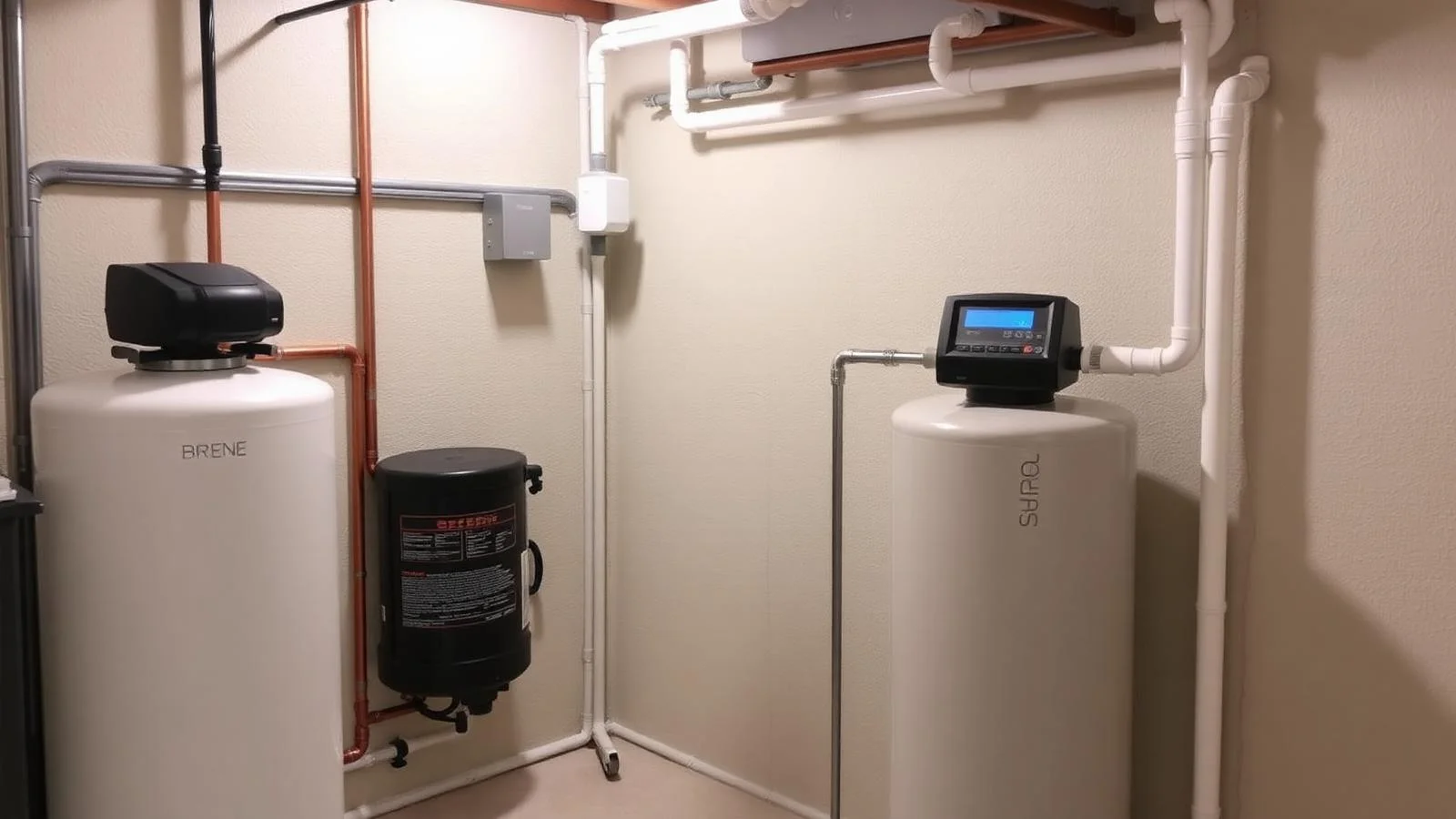
Loop tied in, unit installed, bypass valve set, and drain routed correctly.
Programming and walkthrough
You'll know exactly how much salt to add, how often, and how to bypass it if needed.
What Hard Water Does to a Utah County Home
You have probably already noticed it. White crusty buildup on the faucets and shower heads that comes back a week after you scrub it off. Spots and a dull film on dishes and glassware straight out of the dishwasher. Soap and shampoo that will not lather no matter how much you use. A slick film left on your skin after a shower. Laundry that needs extra detergent to come out looking clean. Those are all the same problem showing up in different places, and the problem is hard water.
Hard water simply means the water carries a high amount of dissolved minerals, mostly calcium and magnesium. Those minerals do not stay dissolved forever. Every time the water is heated or left to sit and evaporate, they come out of the water and stick to whatever surface is closest. On a faucet you see it as white crust. Inside a pipe, a water heater, a dishwasher, or a washing machine, you do not see it at all, but it is building up the same way.
Water hardness is measured in grains per gallon, and there is a standard scale plumbers use to describe it. Water from 0 to 3.5 grains per gallon is soft. From 3.5 to 7 is moderately hard. From 7 to 10.5 is hard. Anything above 10.5 grains per gallon is classified as very hard. Spanish Fork City publishes its own water quality numbers, and it reports total hardness of 231 to 349 milligrams per liter, which works out to 13.4 to 20.24 grains per gallon. Every part of that range sits above the very hard threshold, and the top of it sits at roughly double that threshold. Hardness does vary from city to city and from one water source to the next, so there is no single number that covers the whole county, but most Utah County homes land in that very hard category.
Here is why that matters to you and not just to a lab. Scale on the inside of a water heater acts like a blanket between the burner and the water, so the heater has to run longer to deliver the same hot shower. That means it works harder and wears out sooner. The same buildup collects in dishwashers and washing machines and shortens how long they last. Inside supply lines, scale narrows the path water travels through, and over time that shows up as weaker flow at the fixtures. And because hard water fights soap instead of working with it, you keep spending more on detergent, dish soap, and shampoo to get results that softened water would give you with less. Our guide to hard water in Utah County walks through the same effects in more detail if you want the longer read.
What a Softener Installation Actually Involves
A softener works by passing your water through a bed of resin that pulls the hardness minerals out and holds onto them. Every so often the unit rinses that resin with a salt brine to clear the collected minerals and reset itself. That rinse cycle is called regeneration, and how often it runs depends on how hard your water is and how much water your household uses.
Sizing comes first, because that is what most bad installations get wrong. Mike goes through your hardness level and asks about how many people live in the home and how you actually use water before recommending capacity. A unit that is too small regenerates constantly and burns through salt. A unit that is too large costs more than the home needs. The goal is a softener matched to real usage, not the biggest box available.
The physical work depends on how the house is plumbed. Many Utah County homes already have a softener loop, a short section of pipe set aside near the main line specifically so a softener can be tied in. If your home has one, the unit ties into that loop. If it does not, a loop gets added first so the softener treats the water going to the house without disrupting anything else. From there Mike sets a bypass valve so the unit can be taken out of the water path when needed, routes the drain line correctly so regeneration water goes where it should, and programs the unit for your hardness and household size. The last step is a walkthrough covering how much salt to add, how often to check it, and how to use the bypass.
Maintenance and Servicing
A softener is not a set and forget appliance, but the upkeep is light. Salt is the main thing. The unit needs salt in its tank to regenerate, and if the salt runs out the softener keeps passing water through untreated, which is why hard water symptoms sometimes come back on a home that already has a softener installed. A check every month or two is usually enough to stay ahead of it.
Over the years the resin inside eventually loses its ability to hold minerals, and settings can drift out of step with a household that has grown or shrunk. Mike handles resin replacement and reprogramming, and he repairs existing softeners rather than pushing a replacement when the unit you have is worth keeping. If a softener is old enough that repair no longer makes sense, he will tell you that straight, and replacements and upgrades are part of the same service.
How This Connects to the Rest of Your Plumbing
A softener is not really a standalone appliance. It protects everything downstream of it. The clearest example is your water heater, since heat is what drives minerals out of the water and onto surfaces in the first place. Softened water going into a tank means less scale collecting on the bottom, which is why water heater installation and repair and softener work so often come up in the same conversation.
The connection is even more direct with tankless water heaters. A tankless unit heats water quickly as it flows through a narrow heat exchanger, and scale in that exchanger is exactly what the annual descaling flush exists to clear out. Feeding a tankless system softened water gives that flush much less to deal with. If you are planning a tankless install, it is worth deciding on softening at the same time rather than after.
The same logic covers dishwashers, washing machines, faucets, and shower valves. Everywhere water sits, gets heated, or passes through a small opening is somewhere scale can collect. Treating the water where it enters the home is the one change that reaches all of it at once.
Common Questions.
Do I really need a softener in Utah?
In most of Utah County, yes. Anything above 10.5 grains per gallon is classified as very hard, and Spanish Fork City publishes total hardness of 13.4 to 20.24 grains per gallon for its water, which sits well above that line. Water that hard leaves scale in water heaters and coats every fixture in the house.
What size softener do I need?
It depends on hardness and how many people live in the home. Mike will size it right so you're not regenerating too often or running out of soft water.
Do you install salt-free systems?
When they're the right fit, yes. Mike will be honest if a traditional softener is a better call for your water.
What does softened water feel like?
Most people notice it in the shower first. Soap and shampoo lather easily, and you use less of both. Some people describe the water as feeling slippery at first, which is just soap doing its job instead of fighting minerals. Dishes and glassware also come out of the dishwasher without the spots and film hard water leaves behind.
Will a softener protect my tankless water heater?
It helps. A tankless unit heats water inside a narrow heat exchanger, and hard water leaves scale in that exchanger, which is what the annual descaling flush clears out. Softened water leaves much less behind, so the unit stays closer to its intended performance between services.
Can a softener be added if my house doesn't have a loop?
Yes. A softener loop is just a short section of pipe near the main line set aside for the unit to tie into. If your home doesn't have one, Mike adds it as part of the install so the softener treats the water coming into the house.
How long does a water softener last?
It varies with the unit and how hard the incoming water is, since harder water means more regeneration cycles over the years. Resin eventually loses its ability to hold minerals and can be replaced, which is often cheaper than replacing the whole system. Mike will tell you straight whether repair or replacement makes more sense for the unit you have.
How much salt does a softener use?
That depends on your hardness level, your household's water use, and how the unit is programmed, so there's no single answer. A properly sized softener regenerates only as often as it needs to, which keeps salt use down. Mike sets the program and shows you how often to check the tank during the walkthrough.
Ready to Get It Fixed Right the First Time?
Call or text Mike directly. Free estimates, same-day scheduling when available, and no surprises on pricing.